
The Aventinus is the heart of the Novissima Ecclesia and therefore of the Sacrum Imperium.
It is one of the seven hills of the Blinded City of Rome. Here, the three angels revealed themselves to the monk Augustinus after he had seen the divine light for a blink of an eye. Rome burned down on the same day, coloring the sky an infernal red and making the scorching air heavy with ash. Blinded by the light, Augustinus, guided by the angel Mare, managed to seek shelter in the Basilica of Santa Sabina on the Aventinus hill. His brothers had fled, but Castell, the angel of the steadfast pillar, raised his protective hand over the church, even as the flames licked at the building and sparks danced across the roof.
The walls and windows blackened with soot, the basilica survived the end of the Eternal City. It was only one of thousands of apocalyptic infernos around the world, the angel of merciful death, Gracia, told the wounded monk. What Augustinus felt and thought in those moments will remain a mystery forever. But we know what he began to do.
He wrote.
Meanwhile, the earth sank into the scorching night, lit only by the countless fires, the torches and lanterns of the survivors seeking shelter and food.
He was still writing when the fires died down.
Icy cold now descended like a suffocating cloth over the land, and dirty snow fell continuously for weeks in some regions.
But Augustinus continued to write in his church, driven tirelessly.
Here, in the Basilica of Santa Sabina, he completed the Last Testament in the third year after the beginning of the end of all things. Here he dictated to the three apostles who had come to him under the snow of a world frozen into ice. Here he died when his task was complete and each of the apostles had an identical copy. He was laid to rest in a simple grave, along with the first draft of the Testament. He had written it blind, his hand guided alternately by one of the three angels, while they recounted events that had once been, those that were happening, and those that would be. After his burial, the nameless apostles left the basilica and went to various places to lay the foundations for what was to come.
The years passed on the Aventinus, and it was mainly lepers and outcasts who found their way here. They plundered what was left, lit fires inside to protect themselves from the bitter cold of the harsh and seemingly endless winters, and listened to the wind howling through the ruins of Rome and breaking accusingly against the basilica. The sky, caught between gloomy twilight and deepest night, offered at most a distant memory of the sun.
When the years of ashes came to an end, the world long since rebuilding itself in a new order, for Italy was now an Ottoman province and the first people ventured back inland to escape the overflowing cities and fished-out coasts. Looters returned to the Aventinus, indeed to Rome in general. Gold had become almost worthless during the winter, but now the powerful were once again greedy for anything shiny. People roamed through the ruins, stirring up dust and ashes, coughing as they rummaged through mud, rubble, and bones to recover valuables from a bygone era.
A brief gold rush, and then they were all gone again.
The land around the Tiber was no longer good land, for in the northwest it was burning again. But it was no fleeting inferno. The fires of hell itself, a gateway down to the underworld, people whispered into the wind, which occasionally reached the old basilica. They called it the Roman Desert, and ash blew from there over the ruins and settled heavy as lead on the roof of the church until it collapsed under the weight. But a far worse fire was to be the true end of the Basilica of Santa Sabina.
That of war.
Why and how there was war may not be the subject here. The whys and wherefores are always difficult to determine, especially in a world where the laws of logic were frayed. The Italian province rose up against Ottoman rule, and at first it was a cat-and-mouse game of the most terrible kind, with raids and murders, attacks and sabotage that shook both order and society. The governor, once appointed with great honor by the Janissary Sultan, was desperate, for he was increasingly becoming the helpless mouse and the rebels the daring cat. So he decided to take a hard line, believing that if the people did not love him, they would at least remain loyal to him out of fear. Wherever anyone believed they had discovered the Three Angels Cross, the symbol of those criminal rebels, destruction ensued.
Lonely farmsteads.
Scattered villages.
Entire city districts.
And when there was nothing left, everything else that offered shelter.
A band of Janissaries, accompanied by mercenaries from the more loyal cities such as Rheggio and Ancona, came to the ruins of the once great city of Rome, and there was not much left that could offer shelter to a man. Fire, snow, and ultimately ash had reduced Rome to a field of rubble. All the more reason for the ruins of Santa Sabina to rise like a queen on the Aventinus above this land.
Get rid of it, the captain of the troop is said to have ordered succinctly.
According to the Novissima Ecclesia, however, one of the mercenaries from Ancona refused. Why he did so, whether it was an act of martyrdom or whether he simply did not see why he should put himself in danger to demolish a dilapidated ruin, is open to interpretation. In any case, he died, and only the foundation walls remained of the Basilica of Santa Sabina. The grave of Augustinus, however, marked by a rotten wooden cross and three heavy stones, remained untouched, for why should one bother with the dead?
And once again, they were all gone.
From then on, the withered grass seemed to tremble when the winds swept unchecked across the hill. He lay there naked, like the ruins all around him. No more people came. Only when the winds blew from the ash desert in the northwest could one hear a whisper. But they were strange sounds, a language that only pretended to be such. Once, the sound of cannon fire could be heard, coming from the sea miles away. A battle?
Mice nested in a hollow in the foundation wall and nibbled on what the sparse shrubs and grasses had to offer. Birds circled above the hill and the surrounding land for only a few hours, if at all, and usually quickly flew south again, as if they had adopted the same uneasiness that kept people at a distance.
These were the last peaceful years that the hill would experience.
The war was still raging, now with full force, with armies and logistics, strategists and daredevils, when builders from Zena arrived. They walked down the hill, took measurements, cleared away debris, and drove pegs into the ground. Voices filled the Aventinus and a tent camp grew at the foot of the elevation, which, some perhaps felt, now proudly shielded them from the strongest gusts of wind from the Roman desert. There was a lot of talking, discussing, and often shouting, but otherwise not much happened.
Until one day, loud cheers erupted in the small tent city. Suddenly, the people who had long since grown weary of this place began to celebrate. Isolated salutes ensured that the mice in their hiding place under the foundation walls of the basilica finally took flight. The war was over.
In Zena, the faceless conclave named the first among them as Vicarius. He was to rule not only over the Novissima Ecclesia, but also over the Sacrum Imperium. The Unicum In Terra Regnum Dei – the only kingdom of God on earth. One of his first official acts was to send masses of workers to the Aventinus.
Not to rebuild what had once been.
The old days were over, for God had brought about the end of this world, and that was good.
Builders were to create something final on the Aventinus, on the ruins of the Eternal City.
The tent city grew incessantly into a buzzing haven of life. It was not only hordes of day laborers who carried and dug, but also blacksmiths and stonemasons, carpenters and engineers, cooks and many other trades, even priests of the church who supervised the construction. The ruins were used as building material, and so the field in front of the hill was leveled, while on it itself a huge structure grew up on scaffolding.
More than three decades were to pass, and in the meantime the world continued to turn faster than ever, for the followers of the Southern Crusade had landed in Sicily, and in the east, soldiers of the Eastern Crusade advanced across the Adriatic, while in the north and west there was friction with the small and great kings of the new era. Instead of avoiding the ash deserts, men now ventured into them, cloaked in protective robes, their guns loaded, their eyes alert… and greedy. Not all of them returned, and not all of those who returned truly came back. Their bodies may have survived, but their spirits were gone. But they brought something back with them. Cinium. Angel white and hard as iron, it left a foul taste on the tongue when it burned. And by God, it burned better than coal and the purest oils.
Iron machines, hissing hot steam, greatly accelerated the construction work. Cranes, pumps, and much more now pounded as if they were living beings in their own right. However, the priests warned that they were ultimately only machines, only dead things, and should not be turned into idols.
In the thirty-sixth year after the arrival of the first master builders, the time had come.
Not completed, of course, but far enough along.
The Basilica Sanctorum Trium Angelorum was inaugurated and occupied in a solemn ceremony by the Vicarius, the Primus Paenitentiae. From then on, it was no longer Zena, but the Aventinus Hill that was to be the center of the Novissima Ecclesia. Far away from the faithful, some voices complained, but only very quietly, for the Church had consolidated its power. Three orders of the Inquisition watched over order with the severity of a chastising father. Times would soon become harder, after all, they were living in the final days of time itself, and that meant, to quote Gracias’ words in the Third Book of the Last Testament very freely.
And should sin cast you a smile,
I must reap it with my scythe.
In the shadow of the mighty dome of the marble basilica, which was in no way inferior to that of the destroyed St. Peter’s Basilica in splendor and, above all, grandeur, all thoughts, whether heretical or pious in nature, vanished in awe. A bell tower rose up from the dome as if it wanted to push open the gates of heaven itself. Three bells weighing several tons performed their endless work inside it and regulated the daily routine of the faithful. Their ringing echoed dully across the landscape and shattered in the north against the first sections of the Roman Wall, which, despite all trust in God, was supposed to prevent the ash desert from advancing to the Aventinus. Adjacent to the basilica, never standing alone, outbuildings offered ample space to accommodate thousands of officials and servants who indulged in their ascetic lifestyle, mass, and prayer.
Castell spoke to the doubting apostle, saying that the foundation of one’s own faith is service to the faith itself.
Decades passed.
The world seemed to be spinning faster and faster as the Eternal Crusades advanced, breaking through the blockade at the Strait of Gibraltar and bringing the first missionaries to the lands beyond the Old World. War was nothing that the Novissima Ecclesia shied away from, but the feather and the word were far more favorable and also in line with doctrine, for why cause unnecessary suffering, which often went hand in hand with new sins, when an invitation to the congregation was enough? And if an invitation was not accepted, well, in Caserta and many other cities there were now factories, and the furnaces burned with such a hot fire that it made steel malleable like wax. War was still expensive, but the church’s economists knew the advantage of economies of scale.
And the ash deserts spread, their ash-gray fingers groping across the land, sometimes full of cold, sometimes full of heat, and sometimes in a white noise that scarred the world, especially the living creatures in it, as no fire could ever begin to do.
Crouched down and forget yourself, advised the wanderers in the borderlands.
Perhaps then you will survive the noise that shatters reality.
Another saying was that only two things came out of the deserts.
Cinium.
And broken spirits.
And one of those broken spirits committed the Red Mass at Aventinus. He had been a guard, even a captain, and whatever he brought back from the Roman Desert made him forge a careful plan. Not the act of a madman, but of a cruel genius whose mind no longer seemed human. The Red Mass would last for days and cost the lives of over two hundred followers of the Church. It was a truly cruel act, but also a lesson whose blood seeped into the hills.
Three barracks were built around the Aventinus.
The Aventini were founded.
Elite soldiers of the Vicarius, clad in sacred plate armor. They replaced the regular guards, who were transferred to the Ash Wall in the north as punishment for their failure. It doesn’t take much imagination to picture the resentment building up in the cramped guardrooms along the wall. The Aventini grew in number, and like everything that proved good and useful, it soon became too much. So the Vicarius decided that three years of war service would be another criteria for earning the right to guard that sacred place.
The world kept turning.
In the east, there was a slow but steady advance, and the Ottoman Empire, one of the Great Old Ones, which gave a glimpse of how the world had once been, broke apart piece by piece. In the north, the missionaries reached their limits, as the Kaiser of the Lohenreich refused to accept that there was a power above him. The Northern Crusade led to the First Lohen War. Meanwhile, engineers tinkered with ever new wonders, and so the first humans rose into the air. But the deserts also spread, and storms of embers and ash swept devastatingly across once green lands. The sky was gray and hazy. In many regions, counters now measured the cinium content in the air, and exorcists of the Malleus Inquisitionis hunted down those who were enraptured, believed false promises, and turned their backs on the church.
The Aventinus was now truly a center of power.
It was also a busy place, because thousands upon thousands of officials and servants had to be provided for. Under strict supervision, villages formed around the three barracks of the Aventini, but they resembled more of a contiguous complex. The houses were connected to each other, most of the streets were roofed, and when the ash winds blew over the wall to the north, the cinium meters on the street lamps cracked in a macabre rhythm and the guards drove passers-by inside with batons if necessary.
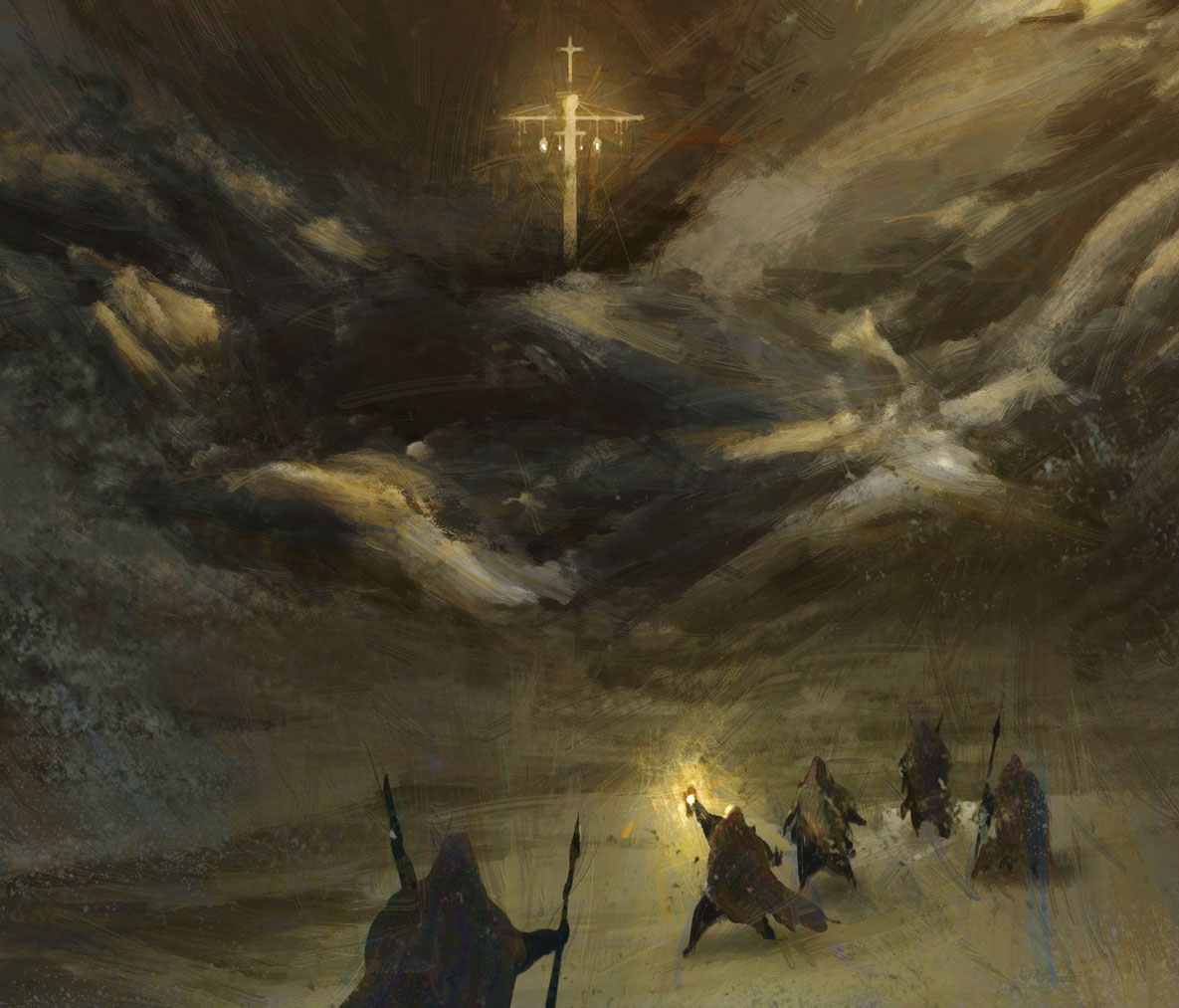
On the Caelius, one of the other hills of the fallen city, a filigree tower rose in the shape of a gigantic cross. An antenna to call into the ether. The officials at the Aventinus were the ones who took care of everything that went beyond the authority of the cardinals in their provinces. And for that, they had to communicate. Over long distances in a world where you had to shout against a storm. Calls through the ether all too often seeped away in the wind, enriched with ash and cinium, sweeping in from the deserts. Whenever a region sank into isolation, only couriers remained to break through the storms and deliver messages.
There was something else, by the way.
People didn’t like to talk about it, because if they talked about it too much, they suddenly became quiet and strangely dismissive from one day to the next. Some also disappeared. Departed, they said. Transferred to a proto-province on the borders of the Imperium.
Surrounding the bell tower of the basilica, the three messengers of the Lord rose up. Mare, Castell, and Gracia. Carved from marble and with outstretched wings, as if they wanted to catch the wind and rise up. Hot steam flowed like warm breath from their open mouths, as if they were more than just lifeless statues.
It was a piece of the puzzle to something hidden.
Another was the pipeline from the Tiber. The water was a gray, opaque broth, and the silent hill itself could testify that some unpleasant people had disappeared into it forever. It was completely unusable for drinking.
The third piece of the puzzle was a heavy truck that came to the Aventinus every few days from the refineries in the south. It was truly a steaming monster and armored on top of that, so that nothing would happen to the cargo – or to the environment that would then be exposed to it. It was an open secret among those who spied on the holy basilica or were simply too curious.
High-purity cinium.
You could taste it in the air when something like that was nearby, because cinium of this purity was volatile, as if it were desperately searching for something to bind to. It settled on the tongue and made everything taste more intense, so that you thought you could actually taste the ash that hung in the air around and above the Aventinus. It was not pleasant.
But what was such elaborately purified cinium needed for?
It was a mystery about which there were theories, and there were theories about those theories as well. The amount of cinium indicated enormous consumption, yet there was no noise or vibration from large machines. The Department of Extraordinary Affairs had long suspected that the Basilica Sanctorum Trium Angelorum was more than just the center of the church and its empire.
Some even wondered if that had ever been the main purpose of the complex.
Cat’s Eyes A short story about two female soldiers from the Communes’ Force Extraordinaire. The story was originally written in German and translated using Deepl, so the translation may sound a little clunky at times. 1 She didn’t feel like she was waking up.[...]
To provide you with an optimised experience, we use technologies such as cookies to store and/or access device information. If you consent to these technologies, we may process data such as browsing behaviour or unique IDs on this website. If you do not give or withdraw your consent, certain features and functions may be impaired.