
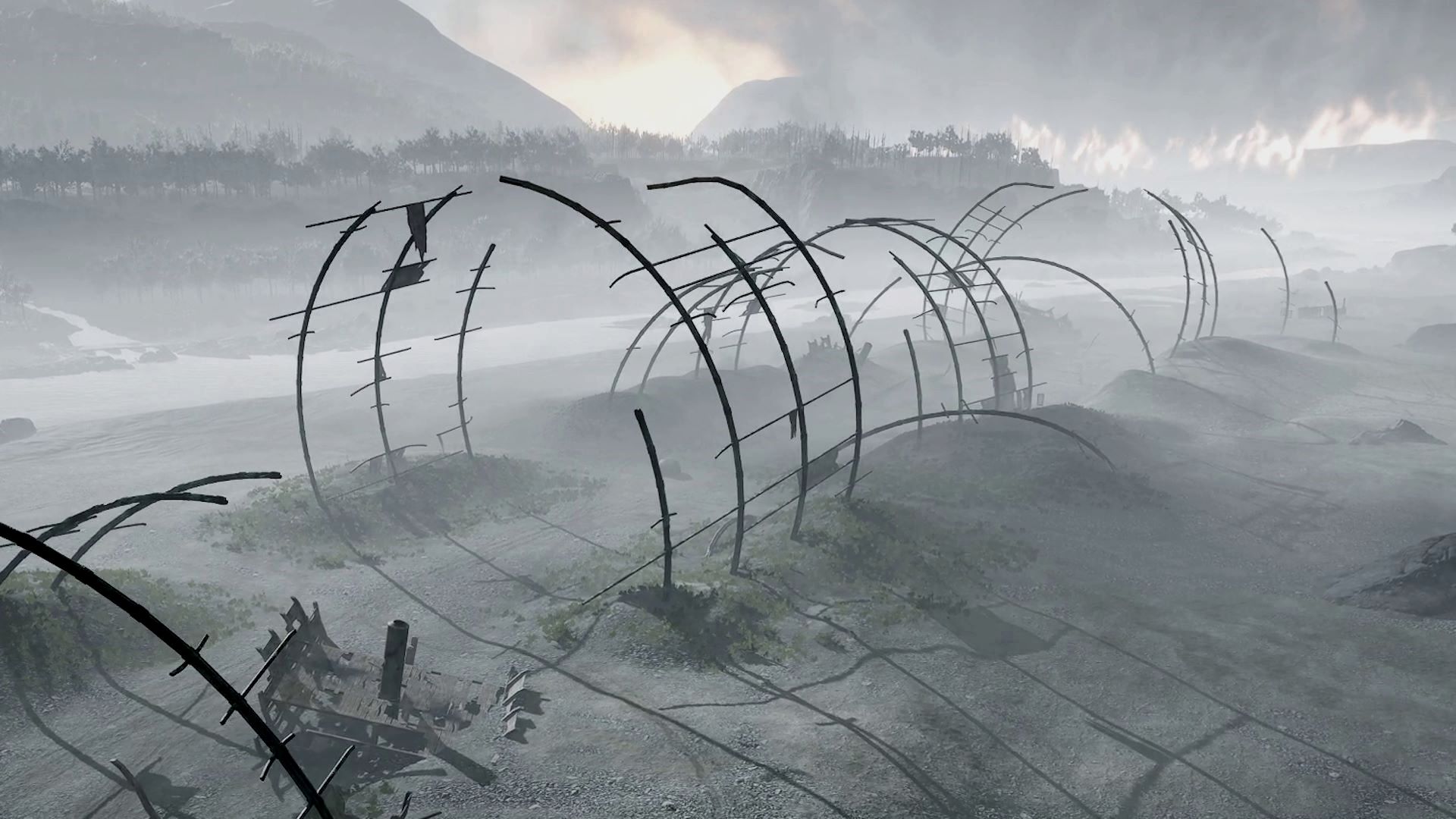
The timeline presents the different eras in order to provide a overview of the chronological development of this world after the Great Inferno of 1704. It is written from the perspective of a seemingly highly educated historian from the Second Commonwealth.
It is not complete and information may still change. Like all lore topics, it is primarily background information.
P.I. stands for Post Infernum.
July 13, 1704 to fall 1704: Stars racing across the globe
How else can it be described other than that on this day, the apocalypse descended upon humanity?
Flashes of light race across the globe like fallen stars. They cut paths through mountains, briefly divide the seas, and slice into the land like a scorching blade. For a moment, the horizon around the world glows with a brilliant light, brighter than anything a human has ever seen. And everyone who saw the light, who looked directly into it, went blind and not few of them lost their mind.
The blink of this heavenly event was followed by a clap of thunder, as if the earth itself were breaking apart. Window panes fifty miles away of the starry path of the heavenly blade of light shattered. And when the lights went out, an inferno took their place. Along the trails where mountains had been split and a aisle cut into the earth, everything, even the air itself, seemed to have caught fire. But while everyone watched the walls of flames on the horizon in fear, another danger came from the sea. A few hours later, the first tsunamis sweep across the coasts, causing cities like Amsterdam to disappear forever.
The fires will rage until autumn, and smoke and ash will turn day into night.
The consequences of all this are still impossible to overlook. The aisles of destruction and divided mountains. The deserts of ash and fire. This is what it looks like when God runs his fingers over the earth. I hardly dare to ask what it would look like if he struck the earth with his whole hand.
Blinded and deafened by the catastrophe, the monk Augustinus begins writing the Last Testament in Santa Sabina on the Aventine Hill in the city of Rome. While the Eternal City is destroyed by fire, the Santa Sabina is miraculously spared. The Last Testament will lead to the founding of the Novissima Ecclesia, one of the most influencial religions in the dawn of humanity.
To this day, historians disagree as to whether Augustine really existed. From sources, we only know that the Santa Sabina actually survived the destruction of Rome before the Ottomans destroyed the church decades later. Of course, one should never express the possible non-existence of Augustine to a follower of the Novissima Ecclesia. Such doubt could lead to a fatal act of grace.
Paris is surrounded by flames and becomes a death trap for countless people. Similar events occur in many other places around the world. The flames seems to be everywhere; in some places, even the ground seems to be welcome fuel for them. The sky is now just a mixture of smoke and soot, its heavy clouds reflecting the roaring flames. Hell, it seems, is now the earth itself. Desperate people and preachers with their followers surrender to the flames, believing that this is the end in every sense.
To be honest, much of the information about the time of the inferno is based on hearsay. Little was written down years later during the long winter, and much of it only when hardly anyone from that time was still alive.
The world has become strangely quiet as an emaciated merchant in Rheggion writes something about the apocalypse in his chronicle. He had heard that the last fires in Sicily had probably been extinguished days ago. It was now raining more frequently. A dirty rain that was not good for animals and plants. In his chronicle, the man complains that the sky is so gloomy, as if God had emptied an inkwell over his earth
___________________________________
This Era is divided into two separate periods.
Hot ash that has risen into the upper regions of the atmosphere darkens the sky. It seems unnatural to humanity, because although the sun cannot be seen, a sweltering heat lies over the land. Plants die, and animals with them, and seas of fungi feast on the dead. It is a time of disorientation and growing anarchy. Cities that have survived the inferno are flooded with refugees, and it is only with great difficulty that order can still be maintained. During the course of the scorching night, the temperature will drop sharply as the sun slowly returns as a pale spot of light.
On an island in the Mediterranean, a devout fisherman constantly lights beacons at night to guide those wandering the sea in search of shelter to the safety of the island. After repeated threats, he is pushed into the sea by other islanders who refuse to share their supplies or waste their increasingly scarce fuel reserves. The Last Testament states that the angel of merciful death, Gracia, appeared to the drowning fisherman to comfort him in his final moments.
There are dozens of such stories in the Last Testament, and some of them can actually be verified. For me, this is proof that the Last Testament cannot have been written at the same time, because how could a lonely monk on the outskirts of a destroyed city have learned about such events in a timely manner?
There are many stories of light phenomena during the long night. For example, people in the ruins of Pisa are said to have observed a band of shimmering colours in the sky for hours on end.
Even more eerie are the stories of ghostly phantoms seen along the aisles of the starry paths.
Humanity begins to calculate time in a new era. European scholars now refer to this new era as Post Infernum. One of the first documents to bear this era designation is a document about the meager food and fuel supplies in the fortified monastery Abbaye de Lérins. The year of the conflagration is designated as year 0.
Of course, this also happened in many other regions of the world.
Dirty snow covers the world like a suffocating blanket. Bitter cold and silence descend. In the first year, their seems to be no summer. In the second year and many following ones, the summers are more like short springs. All life is focused solely on surviving the bitterly cold winters. It is a time of isolation and close-knit communities that chase away all strangers and constantly fear attacks by wandering warlords. Lawlessness reigns supreme, especially on the seas, and once-proud fleets now plunder the coasts as pirates. Under these circumstances, most of the remaining empires and ruling houses collapse, while here and there, limited order and authority are maintained. For many years, humanity will fight for survival as if in a feverish sleep before the dirty snow and rain wash the worst of the ash from the atmosphere and the long winters slowly come to an end.
In academic circles, this era is also referred to as The Funeral of the Old World.
Pirates terrorize coastlines around the world. Both warships and merchant ships have left the ports of hopelessly overcrowded cities and will shift their focus to raids and looting in the coming decades. Unprotected villages quickly fall victim to pirates, driving even more people into the overcrowded cities. It is said that in the bleakest times of the Ash Years, the attackers mainly kidnapped people to eat them – The Red Raids.
Whether these Red Raids actually took place has not been proven. However, since cannibalism exerts a strange and disturbing fascination on many scholars, this legend persists. Perhaps I lack the experience of imminent starvation to be able to understand such a desire.
At the height of piracy, the pirates’ home ports develop into veritable strongholds that are able to build up a modest prosperity (for the circumstances at the time). Montecristo, starting as a neutral trading center off the west coast of Italy, rises to become a beacon in the midst of the freezing cold and long nights.
The persistent cold and shortages lead to the expulsion of tens of thousands of refugees, who have sought shelter in recent months in the city of Narbonne in southern France and the surrounding area, which has been spared from the inferno. The expulsion triggers a population migration that costs tens of thousands of lives and leads to increased settlement in southern Spain and an oversupply of slaves in North Africa.
The sultan of the Ottoman Empire has been barring himself in Rumeli Hisarı, the Rumelian Fortress, for three years at this point. Contact with the outside world has largely broken down, and although Constantinople has been spared from the inferno, the city has descended into anarchy due to hunger and cold. Since uncontrolled people tend to burn things down, it is nothing short of a miracle that the city was not accidentally destroyed by a man-made fire.
In the early morning of February 17, the Janissaries assassinate the Sultan in his chambers, along with his relatives and favorites. His head is then displayed on a stake on the walls of the fortress. The Agha, the leader of the Janissaries, took the place of the sultan. A chronicler would write in the coming months that “the state is now ruled like an army and the population like soldiers.” With merciless harshness, a fragile order was restored, while war was declared on pirates such as the Dey of Marmara, who had attacked the city several times. In the coming decades, the Agha would found a new dynasty and begin the restoration and expansion of the Ottoman Empire, which will have heavy influence on the whole Mediterranean.
Venice, which had survived the last few years better than other cities in the region, began a war against the pirate lords in the Adriatic Sea, who repeatedly plundered the coasts and attacked fishing boats. Since the seas were the most important source of food at that time, Venice had no other choice and the Pirate Lords were too self-confident to give in.
The war is characterized by skirmishes, raids, and ambushes, rarely involving more than three or four ships. The war will secure Venice’s supremacy in the Adriatic Sea and enable the lagoon city to restore part of its trading network, while the pirates were driven away or destroyed.
Soon, only ships with a certificate signed by the Doge will be allowed to sail in the Adriatic. Other cities in the region have no choice but to accept this. Most of them will involuntarily become client states of Venice over the course of the next decade. A situation that will rightly cause resentment. Venice also expanded its network beyond the Adriatic Sea, but it lacked the power to defeat the pirates there, while the pirates were reluctant to plunder Venetian ships. One could say that a fragile balance was established.
An Ottoman fleet explores the situation in the western Mediterranean and demands tribute from the cities along the coast. Cities such as Trapani in Sicily that refuse to pay tribute are conquered, their populations partially enslaved, and burned to the ground. The Ottomans were the death knell for many cities that had survived the inferno on the coast. And it is not without a certain irony that the Sultan would later complain about the economic weakness in those regions.
After the first expedition, the Sultan decides to collect tribute annually.
Until the 43rd year, Ottoman raids will take place almost without interruption, causing fear and terror along the coasts. However, they also bring traders with them and a lively exchange of goods takes place, even though it is not uncommon for desperate parents to sell one or even several of their children in exchange for food or passage to east.
The west coast of Italy, Occitania, and parts of the Iberian east coast, are most affected by the Ottoman raids. Venice, seeing its sphere of influence threatened, will take countermeasures that will later lead to war.
You’re probably wondering, a bathhouse? Does that really belong in a chronicle of the most important events in post-Infernal history?
Well, the world doesn’t always revolve around war, my dear readers.
The Spiegelbad in Wismar says a lot about the situation in the Baltic region at that time. The city was obviously well supplied and protected – thanks to the Swedish fortifications built before the Inferno – to be able to embark on construction projects. Winters in that region were particularly dark and long, as they were everywhere in the north, but even then there was a brisk trade in cinium, often called Engelweiß in German, from the Silesian Desert to the Pomeranian coast.
This in turn tells us that people at that time already knew how to use cinium safely for large heating systems, and sources from that period report that admission was cheap and even free on sundays. Cinium was therefore available in sufficient quantities to enable highly efficient operation.
In the Commonwealth, people often wonder how the Lohen can be so far ahead of us in the use of cinium. Well, this is precisely why.
___________________________________
With the end of the long winters, a phase begins that is characterized by strong population growth and a reorganization of society beyond the often isolated regions. Wherever it is safe, people are drawn from the overcrowded fortified cities to the countryside. But it is a harsh restart for the agriculture, because especially in the north, seeds and cultivated lands are rare. In other regions, the end of the long winter often marks the beginning of a period of prosperity.
The world is also becoming more dangerous in another way. The weather gets suitable for long journeys and raids. Some do not flee the cities to earn their living as farmers in the countryside. They join a warband or army for glory, honor and mostly plunder. Previously independent cities form alliances and coalitions or seek the protection of a warlord or crown. The war is coming back and the world will see hundreds of smaller and larger empires rise and fall in the next seventy years.
At the begin of the Post Infernum, there is a shortage of labor everywhere, especially in those areas that have suffered particularly badly during the winter. And, of course, where the majority sees a problem, others see an opportunity. Slave hunters take advantage of the situation to roam the countryside and capture slaves for the large markets, such as those in the Ottoman Empire and Andalusia.
The use of Cinium also spreads, mainly as fuel for heating stoves and light sources. The potential has not yet been recognised, but there has also been a lack of opportunities to exploit this potential. Over the time it will gain in importance. First inventors will build steam engines, even though the market is not yet ready for them.
Some of you may wonder why this era is called Post Infernum. On the one hand, it is because the effects of the inferno had finally faded by this point (At least that was the thinking at the time of the naming), and on the other hand, it is probably because the academic world likes to confuse the general population.
While the old church was able to maintain its position in the old cities, a new movement of Christianity spread throughout the newly founded villages in Italy and other parts of southern europe. Unlike the old church, the priests of the Novissima Ecclesia preach a message that is suited to the changed world in which people now live.
Above all, they preach hope and a clear goal for every believer: penance. In the year 61, the bishop of Zena converts, thereby driving the leaderless Catholic Church out of Italy’s first major city and many other cities in the region will follow soon.
To describe the situation in inland Europe after the long winter as confusing would be an understatement. The name ‘War of the Thousand Crowns’ does not come from the fact that there were exactly a thousand old and supposed noble families fighting for supremacy. No one knows exactly how many there were in the end, and the number thousand seemed appropriate to express this state of affairs.
The Ash Years took a terrible toll on all those who did not move to the coasts. Away from the seas, temperatures fell even lower than they already were and agriculture came to a virtual standstill. Domestic trade collapsed under metres of snow. Scholars believe that approximately 85 to 90% of the population died in the early years. Hunger, cold and associated diseases decimated the population.
Over time, cities such as Würzburg built large complexes of greenhouses, which were initially heated with wood and coal and later with cinium. The idea was not new, and so a reliable basic supply was established within the first decade, but for most people it was already too late by then. Outside the cities, in villages and hamlets, survival and death were often a matter of chance and luck. On the one hand, there were not so many mouths to feed and the remaining wild animals provided precious meat, but on the other hand, many villages became the first victims of roving raiders who mercilessly plundered unprotected settlements.
This ruthless period certainly deserves a work of its own. In the context of this chronicle, my aim is to show that what remained far away from the coasts were hardened communities that had survived cold, hunger and raids. Generally speaking, it is these communities that form the core of what we today like to call Lohen – even though the similarities in terms of language, culture and ethnicity are only limited. When the winter lost its murderous severity, countless independent communities existed inland. At first, the newly liberated land seemed endless, but soon a race began, especially as powerful city-states such as Stralsund and Wismar, which had survived the bitter winter much better, now pushed forcefully inland. This development can be seen in many regions, even those whose coasts were severely devastated by tsunamis.
The city-states and small kingdoms in the Baltic region in particular were superior to their inland rivals in many respects. The population of a single coastal city sometimes exceeded the population of entire inland regions. Thanks to merchant shipping, goods were exchanged and gunpowder was readily available, while inland regions had lived in self-sufficiency for many years and now used crossbows instead of muskets. As the city-states expanded from the coasts, the locals were either driven out, subjugated, enslaved or slaughtered. The years of ashes had made the people uncompromising, and outside the communities, only the law of the strongest applied.
But soon prosperity flowed into the inland areas, whether subjugated or not. The people on the coasts craved everything that did not come from the sea. The meat of wild animals, furs, metals, wood and, above all, cinium. Apart from the lawlessness outside the settlements, it was more a time of trade than of war. The population exploded. Whereas coastal towns such as Wismar had for years imposed oppressive taxes on every family that had more than three children over the age of ten (many children died before reaching the age of ten), every family that gave birth to more than five children was now rewarded with land. Especially in summer, goods flowed from the coasts to the interior and from the interior to the coasts.
Meanwhile, borders changed here and there, mainly at the expense of inland communities, as the increasingly powerful city-states on the coasts saw little point in falling behind by waging war against their peers.
However, as we know, everything comes to an end.
In 50 AD, the Danzig War broke out over trade restrictions, as Danzig banned the import of furs into its port after traders from Livonia and Sweden had flooded the market. This was followed in 55 to 56 by the Stralsund-Wismar Fishing War, and in 58 to 63 by the war over the Engelweiß Strait in the Oder region, which was crucial for the transport of cinium from the Silesian Desert. Several cities and warlords fought more bitterly than ever for the lucrative trade.
Inland rulers and cities took advantage of the weakening of the coastal empires, demanding land, privileges or even tribute. And where demands were refused, war inevitably had to begin, for a ruler does not like to be offended, as any contradiction undermines the foundation of his power. Stralsund was the first city to feel this when several military campaigns invaded its Pomeranian lands.
From the year 61 onwards, it is indeed appropriate to speak of a war of the thousand crowns. However, one should immediately curb one’s imagination here, because when we speak of war here, we are in most cases referring to conflicts that lasted around one summer. Isolated skirmishes, pillaging and raids were the means of choice, while larger battles were avoided. And if such a battle did occur, it was often the deciding factor in the war.
A mapmaker in Stralsund is said to have declared around the year 70 that it made no sense to draw borders on maps. By the time the pencil was put to paper, another border stone had already been moved five miles.
Whether one believes this exaggeration or not, in 78 AD a man ventured to draw the maps – not least because the kings and city-states wanted to consolidate their claims and rewarded him with plenty of silver and gold.
And what do we see there?
Countless small communities gave rise to larger empires such as the Kingdom of Graufranken, which were often decentralised and based on a feudal system. It was not a system to which the majority of peasants voluntarily submitted, but rather an imposed necessity of the time. Men had to bear arms, especially when it came to invading other lands, without neglecting their field work in the summer. Over time, especially with the beginning of the Lohenreich, the system would become stricter, because serfs still lack the united power to strengthen their position in society. In addition to the feudal empires, whose ruling caste could confidently be described as warlords who had risen from bands of mercenaries and robbers – may the noble houses forgive me for this choice of words – there was a republican system in cities such as ancient Passau and, of course, the city-states on the coast.
The disadvantage of these republican city-states and territories in this war for supremacy was that it is rather difficult to force a large part of the population to work extra hard or go to war when that very population exercises a certain degree of power over the council. The republics therefore remained far more passive, and some preferred to submit voluntarily in exchange for partial autonomy. This may seem weak and cowardly to us, but more of these city-states survived in partial autonomy than there are noble families from that period left.
From the year 84 onwards, scholars in Central Europe spoke of a race for the Kaiser crown.
We will now take a closer look at one particular person in this context.
Konrad von Weilsburg.
The second-born son of a noble family from old Bohemia. To this day, it remains unclear whether the Weilsburg family existed before the Great Inferno, although the Lohens naturally claim that it did. As is still customary in feudal states today, Konrad, as the second-born son, was drawn into the art of war. First among the Weilsburg men-at-arms, then as captain of a free company that fought on the side of the Graufranken in the Swabian uprising for a year and then on various sides in the Silesian campaigns from 75 to 78. Over time, his company grew to a considerable size and consisted of hardened veterans.
Then Konrad got lucky (or unlucky, if he had liked his brother), because his brother died in a fire caused by an ash storm, which was still quite rare at the time. His brother had already inherited Weilsburg and the surrounding lands from his father and sworn allegiance to the King of Old Bohemia (there was also an anti-king in the west, the King of New Bohemia). Konrad returned to his homeland with only a handful of companions to claim his family’s inheritance.
We can only speculate about the reasons for what happened next. Some claim that Konrad von Weilsburg was outraged by the high taxes imposed on him by his feudal lord. Others explained that his king had called him a vagabond when he swore allegiance, and most of the neighbours of the later Lohenreich empire believe that Konrad was simply a war-obsessed madman.
He had his troops, who were still encamped in Silesia, discreetly brought to Old Bohemia and hidden in the ruins of the old city of Prague. When everything was ready, Konrad von Weilsburg laid claim to his king’s throne. You must know, my dear readers, that there is a painting in the Long Gallery at High Council Square in London. It shows the expression on the face of Albert II of Old Bohemia as Konrad’s adjutant hands over the demand for the surrender of the crown, while Konrad’s troops march in the background with waving flags.
It is the perfect mixture of disbelief, a twisted mouth on a wrinkled face suggesting laughter at a bad joke, paired with wide eyes that convey a subliminal fear.
Konrad became king of Old Bohemia, and when the king of New Bohemia went to war against him, knowing well that Konrad had not yet consolidated his power and that his vassals did not support him, the genius of Konrad and his generals finally came to the surface. The King of New Bohemia died in the third and final battle, and in 84, Konrad united Old and New Bohemia. Through the mediation of his cousin (a woman who made it her lifelong mission to conceal Konrad von Weilsburg’s diplomatic incompetence) he married the daughter of the King of Pomerania, thereby gaining considerable influence over the lucrative Cinium trade in the north.
Now the race for the imperial crown had begun.
Seven years of military campaigns took Konrad from his homeland to the rugged coasts. He defeated the old powers of Stralsund and Wismar in the Battle of Pomerania, drove Skandia’s army back into the sea on the North Sea coast, and finally, where it had all begun, in Bohemia, faced the mighty army of the King of Graufranken and his allies, who had become his greatest rival.
This was followed by the Battle of the Moldau, several weeks of fighting in the Grey Forest near Prague, and finally the clash on the Totenfeld – the original name has been lost, or perhaps the place was never named. The rapid succession of battles had led to the depletion of gunpowder supplies, and now both armies were engaged in hand-to-hand combat.
However, Konrad had a company of Jäger in his army. They served as scouts in difficult terrain. These Jäger carried crossbows, which were not uncommon among the Lohen at that time. The Jäger attacked the Graufranken and their allies from behind late in the evening of the battle. They fired volley after volley before a bolt struck the fighting King of the Graufranken in the chest.
‘Damned crossbows!’ he is said to have shouted in a rage before his companions hastily carried him off the field.
The battle came to an end shortly afterwards.
The Lohenreich was proclaimed six months later on 5 June in Würzburg. Konrad I of Weilsburg united a territory that was surpassed in Europe at that time only by the Ottoman Empire. He appointed his most loyal generals as rulers of newly founded duchies that were loyal only to the emperor. Among other things, the lands that comprised the Kingdom of Bohemia became what is now the Altkaiserland. Konrad showed mercy to his former enemies, allowing the King of Graufranken, who had unexpectedly survived the crossbow bolt in his chest, to keep part of his lands and granting his son the Kurwürde that would come into effect if the Weilsburg dynasty were to die out one day and the Reich would have to elect a new Kaiser.
A large Ottoman fleet lands 44 P.I. at Saraùsa and annexes the city, which submits to this fate without much resistance. Saraùsa had previously served as a port of call for Ottoman raids and had adapted accordingly. The annexation of the city, which marks the beginning of the conquest of Sicily, also marks the beginning of the conquest of Italy.
There is isolated resistance, especially in Rosalia, formerly Palermo, which enjoys Venetian support in the form of weapons, supplies, and mercenaries. Due to the small size of the contingents, the fighting drags on for several years until the Ottomans are able to build up an overwhelming superiority through further reinforcements.
The Ottoman-Venetian War from 50 to 57 P.I. lasts seven years and begins with the blockade and first siege of Reggio, a city that has since become a Venetian client state. Thanks to their spy network, the Venetians are forewarned and the Janissaries encounter strong defenses. Venice therefore has the upper hand at the beginning.
Not only did the Janissaries have to break off the siege of the city, they were also confronted with a flare-up of rebellion in Sicily, followed by a Venetian blockade of the island.
As a result, Sicily became the scene of a war characterized by ambushes and raids, while minor skirmishes took place at sea. Venice shied away from a decisive battle, while the Ottomans were able to build up their strength thanks to a seemingly endless supply of reinforcements from the eastern Mediterranean. Venice’s strategy of driving out the invaders with a single decisive blow had long since failed after two years.
Sicily once again falls completely under Ottoman control.
In 54, the Second Siege of Reggio begins, and while Venice has to commit a large part of its resources to defending the city, the Ottomans have sufficient capacity to invade western Italy and subjugate Venice’s allies and client cities in Occitania.
Bit by bit, Venice loses its influence beyond the Adriatic and is soon unable to supply Reggio. The city becomes largely isolated and finally falls in 55. The Venetian fleet, which repeatedly attacked the Ottoman supply columns, is severely weakened at this point. There is a shortage of gunpowder and ships, and increasingly also of men capable of fighting. A Venetian envoy is rejected by the Janissary general on the grounds that their crime of opposing the Sultan is unforgivable.
An example must be made to cement the Sultan’s rule in Italy.
During the comparatively mild winter between 56 and 57, Taranto and Ancona break away from Venice. While the lagoon city is threatened with destruction, its allies are offered conditions that are in some cases better than those they had enjoyed under Venetian rule.
On April 17, 57 PI, the final act in this war begins.
A sizeable Ottoman fleet for the time appeared off Venice, and the city, in a last-ditch effort, threw all its ships against it. Everywhere in the lagoon city, those residents who were too old or too young to fight listened to the noise of the cannons. One could even imagine hearing the cries of the men as they fired and struck with wild roars. Boys run up and down the city towers to report to the anxious crowds in the squares which ships are currently engaged in battle.
The battle lasts until evening, when the cry rings out.
“They have the Capitana!”
At that moment, lamentations break out throughout the city and a movement to flee begins. The inhabitants, who had hoped for a miracle until the very end, now try to flee before the Janissaries complete their encirclement of the city. With the remaining garrison, the hordes of people try to flee inland, while the irregular Başı Bozuk repeatedly swoop down on the groups like birds of prey to take spoils and slaves.
That same night, the Janissaries enter the city. They loot it and put the remaining population in chains. Constantinople is in desperate need of laborers for agriculture and to repopulate areas that have been depopulated, having lost a large part of their population during the years of ashes. After a week of looting, the complete destruction of the city begins.
By decree of the Sultan, the Ottoman provinces of Sicilya, İtalya and Oksitanya are established. In the period that follows, the Sultan’s soldiers are quartered in the most important old cities that survived the years of ashes. For the time being, the administration of the cities is left to the locals under supervision.
Four years later the corsairs of the largest Barbarby States were defeated in the Battle of Tunis by the Ottoman fleet. The Barbary States became vasalls of the sultan once again and and lost much of their influence and power. The Mediterranean was united into one large domain for the first time since the fall of the Roman Empire. Trade experienced a rapid upswing, and with it prosperity. The Ottoman Empire reaches its greatest extent.
In academic circles everyone knows, that there is a Report 72. Everyone seems to agree that it is highly significant for the High Council of the Commonwealth, but those who would tell you about it do not know its contents, and those who do know are as silent as a grave.
Of course there are rumours about the content, but they are absurd. Aren’t they?
Most would say that it began with the sermon in Zena. The bishop there had raged against the Janissaries’ Devshirme, and not for the first time, so this time, on the governor’s orders, the governor had his soldiers standing by in the church. They tried to arrest him… and failed catastrophically, in the sense that over a hundred people died and a rebellion broke out that set all the Ottoman provinces in the western Mediterranean ablaze within a few weeks.
But I say that the uprising began twenty years earlier. When the Novissima Ecclesia slowly ventured out of the newly founded villages into the old cities and, contrary to expectations, flourished in those corruption-ridden holes. For the governor should have intervened back then, but anyone who keeps one eye on Constantinople is bound to overlook such trifles. The Catholic Church had resigned itself to its fate; there would be no new pope, and so the governor was not in the least interested in the internal religious conflicts of Christendom.
But the Novissima Ecclesia?
A new church does not arise because it accepts the status quo. It arises because it has a vision.
And this vision began to unfold in the year 81. The uprising was not a spontaneous wildfire. It was planned, even though there is still no evidence of the infamous Hidden Curia. Venetian gunsmiths who had escaped the destruction of their homeland had been hidden by the Church in northern Italy. A region thinned out by the long winter, which the Ottomans had marked as their territory on a map at best, without a single Janissary ever setting foot there. They manufactured the weapons that would enable the uprising, just one day after massacres in the church, to storm the Ottoman arsenals in Zena and Ancona, where they got their hands on cannons and gunpowder. Luck and masterful planning, one might say.
The only thing more successful was the timing of the uprising.
It was perfect.
Three months earlier, most of the Janissaries had been withdrawn from the provinces of Italy and Occitania and had just reached the Persian border. A border conflict had escalated to such an extent that it had developed into a war for supremacy in the region, which the Sultan could not afford to lose under any circumstances. When news of an uprising in the western Mediterranean reached Constantinople, there was little the Sultan could do. He lacked the men and simply the will to make further efforts to effectively support the economically weak provinces in the west. The Sultan is quoted as saying that the Italian coast had been more valuable when it was simply plundered annually and the cities were forced to pay tribute.
It did not help that the governor of İtalya was in disfavour with the Sultan. At the same time, it drove the man to fight like a cornered animal and take increasingly harsh measures against the uprising. As history shows, this is often a double-edged sword that either eradicates the root of all evil or makes the whole situation significantly worse.
The latter was the case.
The war was a game of cat and mouse, although it is difficult to say who was the cat and who was the mouse at any given time. In general, it can be said that the rebel commanders were extremely good at judging when to fight and when to retreat. This was especially true of those who belonged to the Novissima Ecclesia, while famous captains such as Francesco Matteo Calderi fell into an Ottoman trap after only a year and were killed.
The Ottomans were the stronger force for a long time, especially on the coast. But the big battles did not take place until the war had already been decided. It is noteworthy that cities such as Zena fell into the hands of the rebels at the beginning of the war, yet were deliberately abandoned to avoid a siege battle that the Church would probably have lost at that point. It is a foresight that is equated with divine providence, especially by followers of the Novissima Ecclesia.
Largely abandoned by the Sultan and increasingly isolated from the surrounding area, the governor finally fled his palace in Rheggion in the winter of 87. He sought the protection of the Dey of Tunis, who, however, had him handed over to the Sultan a year later. For the sake of the reader, I will not go into detail about the circumstances of his death.
At this point, Sicily and parts of Occitania were still under Ottoman control. Meanwhile, the Last Church used the time to take over power. In the summer of 87, a curia consisting of the cardinals of the ecclesiastical provinces, some of whom had only recently been appointed, would elect the first Vicarius and proclaim the Sacrum Imperium in Zena.
(91 P.I.) Proclamation of the Lohenreich in Würzburg
Maybe it was an early sign of wanting freedom that made a servant at the Occitan royal court build and test the first hot air balloon. The warm easterly winds, heated over the desert of Lyon, carried the inventor several miles in his balloon, where he caused considerable panic in the village where he landed with his monstrosity – according to unconfirmed stories, the local priest of the Old Church accused him of witchcraft.
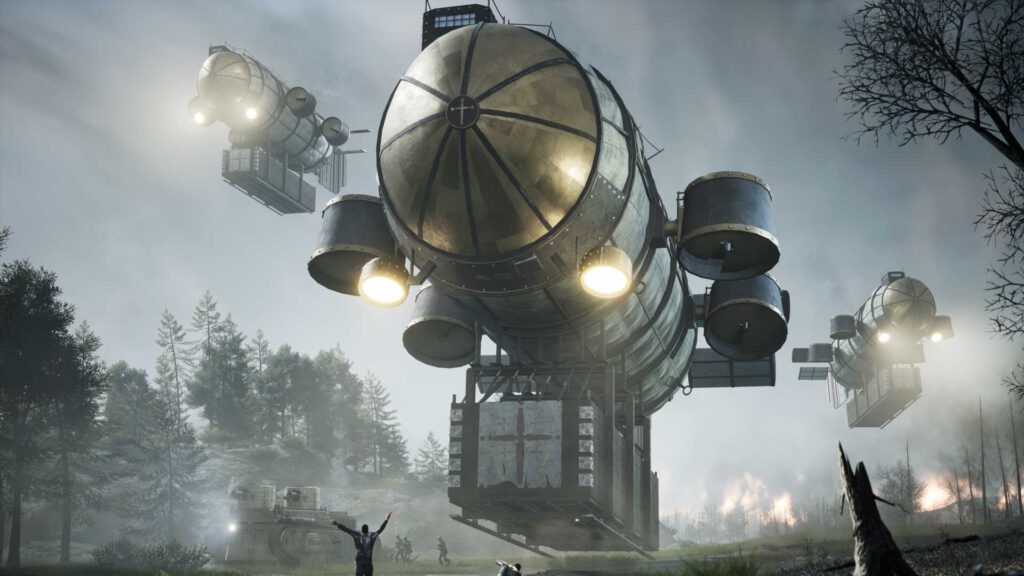
This was the starting point for a development that would gain considerable momentum with the introduction of more compact steam engines and the discovery of hydrogen. Gigantic airships became objects of prestige, similar to warships at sea, only much easier to set on fire. Airship hangars and landing stages were built in cities. Travelling in these gentle behemoths was never really cheap, but anyone who considered themselves someone of importance did it anyway.
In the wars of the 150s and 160s, it was zeppelins that dropped bombs on cities for the first time, causing terror and fear among the population. Even today, especially in the southern lands of the Lohenreich, one can still find cannons weighing tons with extra-long barrels that were designed to shoot mines miles into the sky to ward off zeppelins.
The decline began as early as the end of the 160s. With the spreading ash deserts and the embers within them, the weather began to become increasingly unpredictable. The operation of passenger zeppelins was discontinued in most regions, the industry for maintaining zeppelins collapsed, and so the maintenance of the remaining zeppelins became increasingly costly. At the same time, the first motorised aeroplanes appeared. They were much cheaper and faster, though not very comfortable.
It’s not that there are no more zeppelins. Even today, a few routes still operate, including the Silver Line between London and Château de Caen, but if we are honest, dear readers, it is solely nostalgia and the desire to hold on to something familiar in this rapidly advancing world that keeps these giants alive.
___________________________________
Several decades of wars and conflicts have exhausted the people. The empires that emerged from them were either able to secure their sphere of influence or would come to an end in the following decades. The golden autumn of humanity dawns. It begins with a phase in which the world appears peaceful, despite further wars. For the last time, the weather seems to be returning to normal. Winters are cold but bearable, and the sky is clear enough for crops to thrive well. Countless new trade routes ensure growing prosperity before rapid technological progress and the beginning of no less rapid industrialization shake society to its core.
Cinium is the engine of this new, constantly changing world. Before the end of this century, steam-powered machines will conquer the seas, the land, and finally the skies. Cinium increasingly appears to be a miracle, and greed for it drives people into the hostile ash deserts.
At the same time, this rapid economic change is causing upheaval in a society that has been fragile since the catastrophe. People who fall behind are plunged into poverty, while the markets are flooded with products. Men and women who were once so desperately needed as workers have suddenly become superfluous. And kings who once maintained order in their lands with swords and muskets are increasingly losing their significance in an age when it is the number of production facilities, not the number of soldiers, that determines power.
Before the Dessheim process was invented, impure cinium was used, which, to put it bluntly, a stoker today would not even touch with tongs. It is simply inferior. It only ignites at a higher temperature, burns irregularly and produces considerably more smoke. Nevertheless, it did of course have clear advantages over wood and coal.
However, scholars had recognised the potential of purified cinium through experiments. For the uninformed among us, it should be noted that even purified, even high-purity cinium is never really pure – even though there are rumours that the Sacrum Imperium can now achieve a purity level of 98,7%. A proportion of foreign substances, caused among other things by oxidation of the outer layer, can never be completely avoided, even with today’s methods. In any case, purified cinium ignites earlier, burns continuously with the same intensity, burns higher depending on its purity, and causes far less smoke, and this regularity is every engineer’s dream.
In 115, Robert Dessheim, a freelance engineer under the patronage of the Fürst of Wannstatt, presented his method for purifying cinium. I will spare my readers the technical details here. The fact is that in 118, the world’s first cinium refinery opened in Weißheim. The refinery would continue to operate until 172, when the spread of the Silesian ash desert led to the evacuation of the area. Of course, the processes were further developed over time, and today there are refineries all over the world.
The use of pure cinium led to an acceleration in the development of steam engines for use in all areas. None of the powerful machines we know today would otherwise be possible.
In 116, the Novissima Ecclesia founded a monastery on the Burnt Island in the Caribbean. The fishing village at the foot of the monastery quickly developed into the first overseas community. The church found favour especially in areas where the fire of catastrophe had raged particularly fiercely and the years of ashes had changed much, but it also encountered determined resistance from those who had not been enthusiastic about the old churches.
What is often overlooked is that at this time, the Novissima Ecclesia had also established itself elsewhere outside Europe. In the Creole kingdoms along the west coast of Africa. From there, the church migrated along the coast to southern and eastern Africa.
(133 P.I.) First electric telegraph line between two major cities
After more than thirty years of construction, the Vicarius and his administration moved from Zena to the Aventine Hill, where the Basilica Sanctum Trium Angelorum stands. The construction work was not completed at that time, and some claim that it still is not. In any case, it became the new centre, which—incomprehensible to many—was built on the edge of the Roman ash desert.
The basilica is a masterpiece of architecture, and all of us who are not followers of the Novissima Ecclesia are grateful to our ambassador, Clarke T. Doyle, for managing to take a few rare photographs of it with a hidden camera during his last visit this summer. I think the word ‘hidden’ already implies that this was a forbidden act. Nevertheless, after his return, he sold the pictures to the newspaper. Why he did so remains a mystery, but some rumour that he used the money to pay off debts, while others suspect a deep hatred of the Novissima Ecclesia. This did not help the already tense relations between London and the Aventine, of course.
The enormous complex on Aventine Hill serves as the centre of the Sacrum Imperium and is home to thousands of officials and priests, surrounded by a ring of tens of thousands of servants and elite soldiers of the Aventini.
And, of course, all kinds of rumours surround the basilica, fuelled by its location on the edge of a desert.
(147 P.I.) Konrad II. of Weilsburg bans the Novissima Ecclesia in the terrority of the Lohenreich
The sole survivor: ‘How can one describe something that God never intended us to see?’
(146 to 147 P.I.) Famine caused by the Ash Summer of 146 in Europe
Behemoth is a term found in both the Talmud and the Bible, referring to a mighty beast. Considering the enormous machines referred to as Behemoths, the term is certainly fitting. The naming of these giant war machines is attributed to the Lohen imperial bishop Benedikt von Talgau, who is said to have referred to them as Behemoths when Konrad III presented the weapon.
The first Behemoth was called Wanderpfalz, which means ‘wandering palace’. It was built by Konrad III, but less for military purposes than simply for prestige. In 147, the Lohen Empire was the strongest power on the continent. The Wanderpfalz was modelled on the warships of the time and had an elongated structure with gun batteries on the sides and in the forecastle. The Behemoth was steered from the stern. Large iron wheels were driven by four separate steam engines. The steering, it was said, could only be described as cumbersome with a great deal of affection. The hull was based on a wooden frame construction covered with iron plates. All in all, the Wanderpfalz was state of the art at the time and introduced innovations in the steering and manoeuvrability of free-moving vehicles of this size.
Of course, the Wanderpfalz was the same width as the Kaiserallee in Würzburg, which led Konrad III to display his war machine several times a year at parades of the Mariengarde. It was a symbol of his power, his wealth and, above all, Lohen technology.
During the revolutionary years from 149 onwards, the Wanderpfalz remained in peaceful Würzburg despite its strength. Although the emperor’s marshals were now beginning to consider the use of this weapon, the obstacles outweighed the benefits. It was realised that extremely meticulous route planning was necessary for this monstrous machine to even reach its destination.
Six years later, however, when the Northern Crusade of the Novissima Ecclesia had been invading the southern duchies for a year, the wandering palace left the imperial residence for the first time. It was a necessary decision. The Lohenreich was fighting on several fronts against revolutionary troops in the west, insurgents in the interior and the crusade in the south.
It is difficult to say what the commander in charge hoped to achieve with the first Behemoth, and unfortunately the files on the mission plan are hidden away in the Imperial Archives. What is known is that the Wanderpfalz took over two months to reach the front and that several counts and magistrates complained that its march through their territory had caused damage to roads and fields.
The march of the Wanderpfalz did not go unnoticed by the troops of the Sacrum Imperium. After all, airships were now flying in the sky at that time and, when the weather was suitable, were conducting reconnaissance far into the hinterland. However, the generals in charge were apparently not concerned or wanted to wait and see how exactly the enemy would use their weapon.
On the morning of 18 May 155, a Behemoth saw its first combat action near the village of Singingen. Despite the steam-powered vehicles already in use in the war, it was an experience that left a lasting impression and fear on the soldiers on the ground.
The mercenary Jan Wegener later reported in his diary:
“At daybreak, we were torn from our sleep. As we stumbled out of our tents into the drizzling rain, we couldn’t see what was causing the deafening noise. The air vibrated in our bones and it stank so badly of Engelweiß that we thought one of the lanterns had burst again. I made my way to the earthworks, where most of the company had already gathered, and looked at the monster rolling across the field four hundred feet away. I had never been to sea, but it reminded me of a ship, towering there with its tall masts and castles. It manoeuvred across the field, leaving deep tracks behind it, and when it turned sideways to the front, the thunder of its cannons rang out. We watched until the afternoon as the land ship’s batteries bombarded the enemy positions. The enemy fired back, but they only had light field guns and the shells bounced off the armour without effect.”
Despite its impressive effect, the Wanderpfalz with its broad sides did not seem to be able to force the enemy to retreat. Two days later, the behemoth was sent charging across the field and into the enemy’s position, but one of its steering wheels broke and jammed, causing the machine to come to a standstill. However, this bold advance was enough to cause the enemy to flee, for now a formidable opponent was in the middle of their fortifications and the crews fired down on them with rifles and cannons, while mercenaries and units of the Landwehr advanced.
The Wanderpfalz would fight in the war until 157, when the Behemoth got stuck while crossing the river during the Battle of the Inn and was destroyed after several hours of artillery fire.
No further Behemoths were used in this war, but the Wanderpfalz had made an impression on military leaders far beyond the Lohenreich.
In the Second Commonwealth, enormous hovercraft vehicles were designed, and the Sacrum Imperium copied the idea just a few years later, as it proved perfect for attacking the coasts and islands from the Ottoman Empire in the Mediterranean. The Lohenreich, on the other hand, was too economically weakened until the 170s to develop a successor to the Wanderpfalz.
Nowadays, behemoths are an integral part of all major militaries. They serve primarily as shock and breakthrough weapons, breaking through frozen positions with brute force. There have been attempts to use the weapons as mobile artillery batteries, but as already the Wanderpfalz demonstrated, this often proved inefficient and even dangerous, as entrenched artillery found an almost perfect target in a Behemoth.
With the introduction of aeroplanes, the Behemoths had to adapt further, and only the future can tell how long such giants can survive on the battlefield.
At midnight on 17 August 149, the downfall of the monarchy began. Rebellions broke out in several regions west of the Lyon Desert, while a storm of ash turned the night pitch black. Arsenals were stormed, barracks and palaces set on fire, and wherever a nobleman or loyal servant of the local crown was caught, he died a horrible death.
In the days that followed, the uprisings turned into a revolution, and within a year, this collective upheaval had spread from the west coast of Iberia to the outskirts of the Silesian Deathlands. Feudal states were particularly affected, but unrest also broke out in the proto-monasteries of the Novissima Ecclesia and isolated cities of the Second Commonwealth. More distant connections to uprisings on the American and African coasts are also being made.
But let me explain the background to this decisive event.
Feudalism in various forms continued to prevail in large parts of Western Europe until the middle of the century. Today, it only exists in isolated enclaves, sometimes in a weakened form. These were many small and medium-sized kingdoms such as the Kingdom of Occitania. There was never a large-scale union such as the one experienced by the people of Central Europe under the Lohenreich. This situation caused ongoing instability, as rivalries between the kingdoms were a source of constant conflict, while high customs duties at the borders made trade extremely difficult.
The situation varied from region to region. On the coasts, especially in the Mediterranean, there were powerful trading cities, some of which dated back to before the Inferno. Loyalty to the respective crown had always been limited there. Measures intended to secure greater control over these cities, such as the appointment of a governor, almost always led to conflicts that quickly escalated into violence and war, such as the siege of Marselha in 117. Inland, on the other hand, much of the land was divided among landlords who had it farmed by dependent serfs. Ironically, it should be noted that this feudal system originated in the city-states on the coasts, which, however, lost control over the landlords over time.
At the beginning of the 140s, the ash desert of Lyon experienced a period of expansion that lasted eight years and plunged Western Europe in particular into crisis. Away from industrial centres, which were at best in their infancy, especially in the smaller kingdoms, the rural population suffered from crop failures. Landlords then raised taxes in order to pay their dues to the king, as they were otherwise threatened with having their land and titles taken away. The kings, in turn, could not lower taxes in order to hide their weakness from other ruling houses. It was a catastrophic chain of events, and soon wars broke out to plunder other lands for what their own could no longer provide. Under the gloomy ash-covered sky, the rural population suffered from agonising hunger, oppressive taxes and marauding soldiers. The serfs were forbidden by their landlords from seeking a better life elsewhere. As a result, uprisings broke out already before the year 149, but these were suppressed. However, the number of rebels grew to such an extent that executing them all would have robbed the landlords of too much workforce. So, for many, the punishment was limited to horrendous fines and physical punishment, which only fuelled the anger even more, until it finally boiled over again on 17 August 149 and could no longer be contained.
Now we know why the uprising occurred, but looking back at uprisings in earlier times, those that were successful did not result in the abolition of the monarchy in the country. Either the rebels agreed with their sovereign on a reduction of duties and taxes, or another monarch took over the reign through mediation between the people and other monarchies. Apart from that, there were cases in which, for example, the Novissima Ecclesia or the Second Commonwealth annexed a border area in return for compensation – and/or with the threat of violence.
However, these were always already established systems of rule that were either continued or replaced by another established system through mediation or force.
This was not the case with the uprisings that arose from the Black Night. Here, a fundamentally new system emerged. That is why we speak of a revolution.
But where did people get the idea for such a revolution in the system of government? Well, my readers, this is where a section on political theory begins. The basis of what we know today as the communes was developed decades earlier in the minds of a few scholars who attempted to solve the problems of their time with new ideas, much like an engineer develops a new machine.
So let us now take a look at a whole series of important personalities.
Orsini is considered the forefather of communitarianism and lived from 77 to 112. He worked for many years as a teacher in community schools in various cities and can be understood as a theorist who wrote down his thoughts and only dealt with their possible implementation to a limited extent. As a child, Orsini witnessed his father and later his two older brothers die in wars. His works therefore deal primarily with the question of how a society without war can be created. The abolition of the nobility and the establishment of egalitarian conditions played a major role in this. Since Orsini recognised elements of his theory in the Novissima Ecclesia, he is said to have been a supporter of the new church.
Orsini was followed by the Occitanians Deures and Thamoutin. While Deures refined Orsini’s vague ideas of a council-based democratic system, Thamoutin turned away from this system and advocated a unified authoritarian central government. He declared, ‘… in a council democracy, every representative would degenerate into a self-interested individual who could not see beyond his own nose.’ The two theorists also differed on the economic restructuring that would be necessary as a result of a revolution. Like Orsini, Deures strove for an egalitarian society, which, according to Deures, could only be achieved by abolishing material inequalities – everything belongs to everyone and no one belongs to anything. Thamoutin, on the other hand, offered a more pragmatic approach and merely envisaged the nationalisation of state-owned goods and businesses, while the common citizen was to be enabled to achieve prosperity through hard work.
Both Deures and Thamoutin built up a following that was concentrated mainly in the cities and growing industrial centres along the coasts. They regarded violence as a legitimate means of liberating the people. Deures died in 132 after his capture during the miners’ uprising, while Thamoutin succumbed to his injuries after an assassination attempt in Brittany in 137.
The theorists Quell, who advocated an open caste society, and Cropot, who was primarily concerned with individual freedom, remained marginal figures who would only play a minor role in the later revolution. They are nevertheless mentioned here because they exemplify the increasingly broad discourse in society at that time about alternative systems of government. This discourse took place despite censorship and persecution, especially in mainland France and the conservative cities along the English Channel.
Adriene Sance is one of the most important figures of the Communards. He was the first theorist to put his ideas into practice. Between 141 and 143, he wrote his manifest ‘Notre route vers l’utopie’ (Our Road to Utopia), which he had printed and distributed in hundreds of thousands of copies. While his predecessors wrote for scholars, he wrote for peasants, workers, craftsmen, sailors and all other members of the masses. He adopted Thamoutin’s ideas of a unified party – an open ruling house of the people – and integrated Deure’s ideas of regional committees for supervision and administration. Economically, he also followed Thamoutin’s lead, but saw the need for nationalisation of all land, as did Deure.
Little can be said about Adriene Sance’s activities during the first weeks of the revolution. The sources are vague and interspersed with Commune propaganda. What is certain is that on 12 September 149, Sance announced the formation of a supra-regional committee in Valenfort, which would later become the Directoire. As chairman, Sance effectively took over the reins of government, secured by commanders of the Free Armies loyal to him.
Weakened by defectors, financial hardship and general chaos, the armies of the small kings steadily lost ground. In many places, there was a lack of support among the population, morale within their own ranks, food and equipment. As a result, the small kingdom of Auvergne fell on 17 September and Noveau Bordeaux on 20 September. On 24 December, the King of Occitania abdicated on the advice of his bishop and left his homeland to go into exile. The situation in Iberia was more complicated, as troops from the Ashin Sultanate advancing from the south caused revolutionaries and royalists to repeatedly conclude fragile ceasefires. In the Lohenreich, on the other hand, the rulers of the southern lands cracked down hard on the rebels, while the situation in the north, especially in the old coastal cities, remained calm.
In the years that followed, the Grand Commune was initially established amid fierce resistance from feudal powers. In 155, Adriene Sance called for a march to Utopia to give the people what not only kings but God himself had denied them. Within a single decade, the Grand Commune had united a larger area than the imperial Lohenreich in the east.
But Adriene Sance was a controversial figure, and in the 160s and 170s, more and more communes split off to pursue their own goals and ideas.
The first war between the Lohenreich and the Sacrum Imperium was a classic example of the Novissima Ecclesia’s strategy.
When the Northern Crusade began its invasion of the southern duchies of the Lohenreich under the pretext of protecting the rights of converted and expelled nobles and persecuted believers, the situation of the empire could not have been more disastrous. The armies of the Kaiser and his vassals were fighting the armies of the Communards in the west and unrest within the empire. When the legions invaded, the brunt of the defense fell on the poorly trained and armed Landwehr.
It is this kind of perfect timing that we see repeatedly in the Sacrum Imperium. Now, of course, one could argue that it doesn’t take much to recognize an emergency of this magnitude, but, dear readers, consider that an invasion of this scale must be carefully planned and prepared.
Just one day earlier, the Duchy of Herdingen had lost a large part of its Kurgarden in battles against the Communards in the west. The duchy was in a state of shock and now suddenly faced invasion by an overwhelming force in the south.
The Northern Crusade advanced across the Alps and from the southeast, reaching the namesake residence of Herdingen after just three weeks. The city fell after two days. In the east, the crusade troops laid siege to the much more heavily fortified Old City of Passau, the residence of the Altkaiserland. The Landwehr units were in permanent retreat and the few men-at-arms on site were either dead or captured. Whether and when reinforcements would arrive was not foreseeable.
Then Duke Ferdinand I of Altkaiserland, who hurried home from the theater of war in the west, announced that all his wealth would go to those who drove the invaders out of the empire. It was common knowledge that he owned many lands, and so tens of thousands of mercenaries, known as the Freischützen, offered their services.
What followed was jokingly referred to, with a touch of gallows humor, as the Passau gold rush.
The legions of the Sacrum Imperium had overstretched their supply lines with their rapid advances and—which I cannot blame the generals of the Church for—had probably not considered that a duke would sacrifice all his wealth to save his homeland. Although, Ferdinand would probably not have had much left if his duchy had fallen to the Church, because the Novissima Ecclesia had already proven at that point that nobles had no legitimacy in its eyes.
After a few weeks, the troops broke through the siege ring around Passau and drove the invaders back many miles from other areas as well.
It was a war that twice seemed to have already been decided. Once right at the beginning and now again, when the momentum was with the daring Lohens.
Instead, the momentum was lost.
The Lohen lacked the strength to defeat the enemy’s legions, and the legions, in turn, found themselves in difficult-to-hold positions that sapped their greater strength. All this happened within the first six months, and when winter set in, nothing moved at all for the time being.
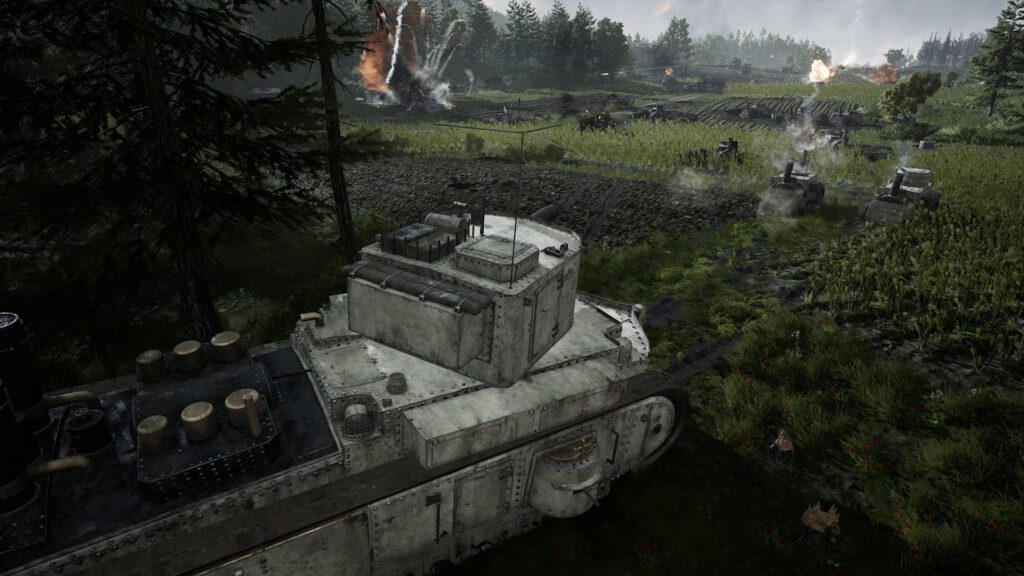
The war would last another four years and can be classified as one of the first industrial wars. Steam-powered vehicles were used in increasing numbers, and what we know today as tanks had their beginnings there. Airships carried out reconnaissance, and telegraph lines brought information from the front lines directly to the offices of marshals and generals hundreds of miles away. Ammunition factories produced around the clock, and artillery proved more deadly with each passing year.
In the end, both sides lacked the strength to bring about a final decision. Despite the improved situation in the west against the Communards, the empire was exhausted and financially ruined. The Northern Crusade, in turn, lacked materials and soldiers, who were diverted by the church to more important theaters of war. Nevertheless, the Novissima Ecclesia was able to enforce some of its demands by receiving parts of the occupied territories and having the Kaiser lift the church’s ban in his empire. The Duke of the Altkaiserland, in turn, kept his promise to the Freischützen and lost a large part of his lands, which led to a long-term weakening of his dynasty and the duchy. After this devastating war, the Lohen as a whole sought peace and stability, and the empire, which had previously dominated far beyond the region, was now ultimately on the defensive.
On the windless and cold morning of 14 March 160, outside Vil-Lys in Commune d’Occitanie, a structure made of fabric and wood took off with two counter-rotating propellers powered by a small steam engine. Louise Moreau lay in the machine and operated the control stick, while her brother, Marcel Moreau, observed the flight. He had persuaded his adventurous sister to do this, as she was significantly lighter than him and Marcel was keen to save every pound to relieve the weak engine.
The aircraft covered a distance of over five hundred feet before Louise lost control and crashed. Considering that Marcel Moreau was primarily concerned with the performance of the design (and less with the safety of his pilot), two miracles occurred at once. Louise survived the accident without a scratch and agreed enthusiastically to further test flights as soon as the machine was repaired.
It was innocent, almost childlike inventiveness that lifted aeroplanes into the sky.
It began in Occitania, and within a few years, other aeroplanes were taking to the skies for the first time in all parts of the world. The dream of flying, not in a sluggish airship, but like a bird, fulfilled these men and women.
The development of aviation is a symbol of how quickly humanity is evolving. Forty-four years ago, the first aeroplane took to the skies, and now there are routes between all major cities that carry passengers to their destinations in no time at all, while the armies of this world are now using it to transport their heavy military equipment to the front lines. Thanks to Cinium, this has become possible in the first place.
(168 P.I.) Commune Military Campaign in the Iberian East Coast
(184 P.I.) Invention of Radio
Experiments conducted by physicians such as Ignatius Cunning and Robert de La Barille in the early 120s already showed that cinium not only causes mental illness, but also has a direct impact on the body. La Barille proved that infants and young children up to the age of six in particular have an increased risk of developing malformations when exposed to elevated concentrations of cinium. In infants, this often leads to sudden death. La Barille’s research aroused great interest among laymen and recognised medical professionals for a long time, but also led to his execution during the revolutionary trials in 149.
In addition, cases came to light in which older children and later adults with cinium levels in their blood exerted a certain influence on their physique and physical characteristics. The number of such individuals is small, but has nevertheless risen significantly with the growing population in recent decades. In many regions, there is a certain superstition surrounding these individuals, accompanied by accusations of witchcraft or demonic possession.
In 186, the newspaper Tireless reported on its front page the discovery of a top-secret project in the Grand Commune. Accompanied by pictures and eyewitness accounts, it was proven that doctors in the commune had succeeded in bringing about specific physical changes using a serum based on cinium and a special therapy.
And that’s not all.
The Armée Unie had already deployed soldiers who had been altered by this therapy and were able to see at night. The newspaper presented a picture of a dead young man whose staring eyes did not resemble those of a human being. He had been killed in combat between mercenaries from the Lohenreich and the Grand Commune.
The outrage among the general population was at least as great as the interest among experts. Cinium has been used as a medicine for seventy years, despite its known side effects. The fact that doctors are able to specifically alter the human body sparked a lasting debate on the topic: ‘Where does a human being begin and where does he end?’
___________________________________
Towards the end of the golden autumn, the weather became increasingly unpredictable. Black storms of ash and white noise swept across entire regions, leaving a trail of devastation in their wake. The deserts of embers and ash lands are spreading, and it seems that they are spreading faster every year. More and more land is becoming uninhabitable, and now the point has been reached where people simply cannot deny it anymore.
The world is dying.
People’s lives, still filled with vague hope during the Golden Autumn, are now getting worse with each passing year. Famines are returning and anarchy is spreading where the land is of little value due to the ash. There will be wars, this time over fertile land, while every year countless people flee from uninhabitable regions.
In this final era of humanity, people are searching for meaning. Empires that are merely managing the end are slowly crumbling, while ideologies that conjure up a goal and hope are uniting the masses.
The question is, will this really be the end?
On 24 February 191, Albrecht I, Kaiser of the Lohenreich, died after a long illness. His only son, Konrad IV, had already died two years earlier in a devastating railway accident. When it became known at the following Lohentag in April that Crown Princess Isabella of Leon had also been missing for some time, the Weilsburg dynasty officially came to an end and an interregnum began.
It was now up to the seventeen Kurfürsten to choose a new emperor. However, this has not happened to this day, as no majority could be found for any candidate. While the south and west of the empire are calling for a new emperor who will resolutely confront the threats at the border, it is primarily the north that is benefiting from the increasing division within the empire.
It remains to be seen, however, whether the interregnum will be the final act in the history of this empire.
On 1 May 204, the Northern Crusade launched its second campaign against the Lohenreich. The reason given was a request for help from the Duke of Morava, who had converted to the Novissima Ecclesia seven years earlier and now intended to assert his claim to the Duchy of Altkaiserland. There is much speculation as to why the duke, who is well aware that the Novissima Ecclesia has little regard for feudal structures, has converted. Some believe that he wants to use the power of the Sacrum Imperium to claim the imperial throne, while others suspect that the Duke of Moravia sees no future for the Lohenreich and its system and believes that radical change is necessary. While his conversion has also led to conflicts within his court, his people stand behind him, hoping for better living conditions under the law of the Church.
At this point, my dear readers, which marks the end of this chronicle, it remains to be seen whether the weakened empire can defend itself against this massive invasion.
To provide you with an optimised experience, we use technologies such as cookies to store and/or access device information. If you consent to these technologies, we may process data such as browsing behaviour or unique IDs on this website. If you do not give or withdraw your consent, certain features and functions may be impaired.